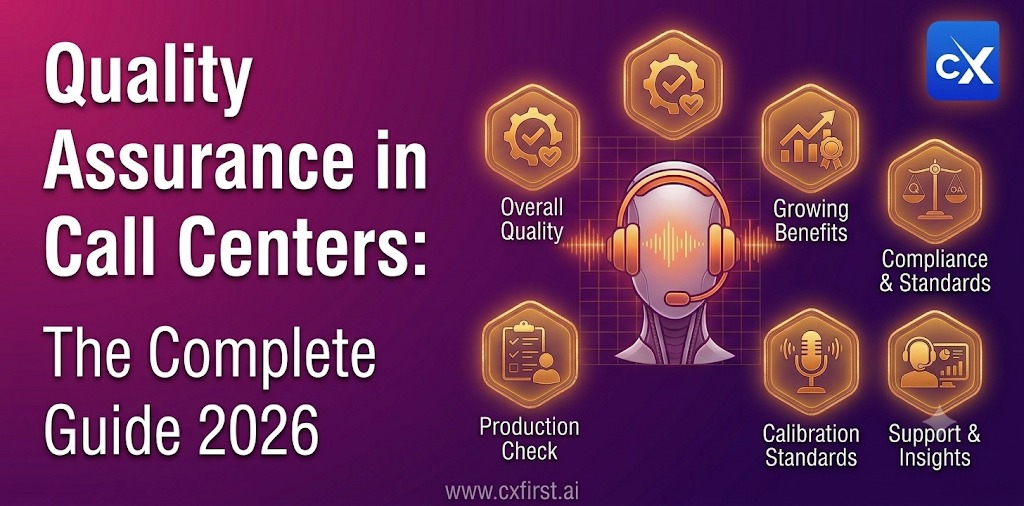
Customer expectations have reached an all-time high, making consistent service quality a baseline requirement for modern contact centers. Therefore, implementing a robust framework for quality assurance in call centers is essential to evaluate interactions, refine workflows, and protect your brand reputation. Beyond basic call scoring, quality assurance acts as a structured catalyst that improves overall agent performance, ensures strict regulatory compliance, and directly boosts customer satisfaction.
In this guide, you will learn what quality assurance in call centers entails, why it matters, best practices, essential metrics, and how AI is reshaping quality management.
What is Quality Assurance in Call Centers?
Quality assurance in call centers is a systematic process used to monitor and refine customer interactions against defined standards. The core objectives of a QA program include enforcing process adherence, maintaining high resolution standards, and driving continuous operational improvements.
While contact center quality monitoring focuses primarily on observing and collecting performance data from calls, emails, or chats, quality assurance encompasses a broader, strategic scope. QA takes that raw monitoring data and converts it into structured scorecards, targeted coaching routines, and workflow optimizations. Ultimately, a well-structured QA framework provides customer service teams with the accountability and guidance needed to deliver superior support consistently across every touchpoint.
Why Quality Assurance Matters in Modern Call Centers
A robust QA initiative directly elevates the overall customer experience by ensuring every interaction is handled with empathy, precision, and speed. Consequently, maintaining consistent service quality builds long-term brand loyalty and reduces customer churn.
Furthermore, quality assurance safeguards organizations by verifying strict regulatory compliance and risk management during sensitive interactions. It empowers agents with actionable insights, turning routine evaluations into continuous learning opportunities. Furthermore, as businesses expand across chat, social, and digital channels, QA provides a unified standard that protects the digital customer experience, guaranteeing high service standards regardless of where or how a customer reaches out.
Key Components of an Effective Call Center QA Program
Building a successful QA framework requires an integrated approach that combines human oversight with deep analytics.
Call Monitoring
Evaluating customer conversations using predefined criteria ensures agents adhere to brand guidelines, protocol requirements, and conversational standards.
Quality Scorecards
Custom scorecards measure critical behavioral skills, including tone, empathy, problem-solving accuracy, and active listening during each interaction.
Customer Feedback
Integrating post-call surveys and direct customer reviews allows operations teams to align internal evaluation scores with real-world customer perceptions.
Performance Analytics
Leveraging advanced customer experience analytics and call center voice analytics enables leadership to spot hidden operational bottlenecks, track long-term QA trends, and identify exact coaching opportunities across entire teams.
Best Practices for Quality Assurance in Call Centers
To build a high-performing QA program, contact centers must adopt proactive, data-driven operational strategies.
Define Clear QA Standards
Establish transparent, objective evaluation criteria so agents understand precisely what constitutes high performance and compliance.
Monitor Every Customer Interaction
Instead of relying on random call sampling, modern contact centers leverage contact center quality monitoring powered by AI to gain 100% visibility into all conversations.
Coach Agents Regularly
Transform QA evaluations into positive growth opportunities by scheduling targeted, data-backed coaching sessions that focus on continuous agent development.
Read more info : https://cxfirst.ai/insightx/
Automate Reporting
Utilize modern quality control management software to centralize reporting, reduce manual administrative effort, and deliver real-time operational insights through automated dashboards.
How AI is Transforming Call Center Quality Assurance
Artificial intelligence is fundamentally revolutionizing quality management by moving contact centers past manual spot-checks. Modern platforms automatically evaluate 100% of customer interactions across channels, detecting underlying customer sentiment and flagging compliance risks instantly.
Moreover, sophisticated contact center analytics software delivers immediate, actionable insights into agent performance trends. During live interactions, AI systems provide real-time agent assistance, surfacing relevant knowledge base articles, compliance prompts, and next-best actions. This intelligent automation ensures every customer interaction remains accurate, efficient, and compliant.
Essential Metrics to Measure Call Center Quality
Tracking key performance indicators provides clear visibility into service quality and operational effectiveness:
- Quality Score: The percentage rating assigned to interactions based on defined evaluation scorecards.
- First Call Resolution (FCR): The rate at which customer issues are resolved during their initial contact.
- Customer Satisfaction (CSAT): Direct feedback scoring measured through post-call surveys.
- Average Handle Time (AHT): The total duration spent resolving a customer query.
- Compliance Score: The percentage of interactions that strictly adhere to regulatory and internal standards.
- Customer Sentiment: Automated tone and mood tracking across conversational touchpoints.
How to Choose the Right Quality Assurance Solution
When selecting modern QA software, evaluate platforms using this quick criteria checklist:
- AI-Powered Monitoring: Full coverage across 100% of interactions.
- Omnichannel Support: Seamless tracking for voice, email, and digital chat.
- CRM Integration: Instant sync with existing data systems.
- Analytics Dashboard: Real-time performance and trend visibility.
- Custom QA Scorecards: Flexible evaluation templates tailored to your business rules.
- Security & Scalability: Enterprise-grade data protection and platform uptime.
Conclusion
Quality assurance is no longer optional for contact centers—it is a critical requirement for maintaining service excellence, ensuring compliance, and scaling operations smoothly. By combining modern AI technologies with structured scorecards and targeted coaching, contact centers can systematically transform agent performance and drive long-term customer loyalty. Continuous monitoring and data-backed feedback remain the cornerstone of any high-performing support ecosystem.
Ready to modernize your contact center? CXFirst helps organizations transform quality assurance in call centers with AI-powered monitoring, customer experience analytics, and intelligent automation—enabling teams to deliver consistent, compliant, and exceptional customer experiences.
Frequently Asked Questions
Quality assurance in call centers is the structured process of evaluating agent-customer interactions against pre-established quality, operational, and compliance standards.
QA ensures that every agent delivers accurate, empathetic, and consistent support, directly reducing resolution times and elevating overall customer satisfaction.
Core metrics include Quality Score, First Call Resolution (FCR), Customer Satisfaction (CSAT), Average Handle Time (AHT), Compliance Score, and Customer Sentiment.
AI automates the evaluation of 100% of customer interactions, provides real-time agent guidance during calls, detects sentiment trends, and flags compliance risks automatically.
Quality assurance should be an ongoing, continuous process. Automated AI systems evaluate interactions continuously in real time, while supervisors should conduct structured coaching sessions weekly or bi-weekly based on analytics data.
Ready to see CXFirst.ai in action?
Talk to our team and find out how an AI-native platform can transform your customer experience.
Book a Demo