Picture a customer who emails your support team on Monday, comments on your Instagram post on Wednesday, then calls in the following week asking why nobody followed up. If those three touchpoints aren’t connected, that customer just became three different strangers to your business. That’s the problem a real customer relationship management process is supposed to solve.
It sounds simple on paper. In CRM best practices, most companies figure this out the hard way – a lead falls through the cracks, a renewal gets missed, someone in sales promises something support never hears about. So this guide covers what the CRM process actually is, why it’s worth the effort, the stages involved, where teams typically get stuck, and how businesses are using AI to close the gaps.
What Is the Customer Relationship Management Process?
The customer relationship management process is a structured approach businesses use to attract, engage, convert, support, and retain customers by managing interactions throughout the customer lifecycle.
There’s a difference worth pointing out here. CRM software is the tool – the database where contact info, deal stages, and email threads all live. The customer relationship management process is what you actually do with that tool. It’s the sequence of decisions and steps that turn a random visitor into a paying customer, and eventually into someone who’s been with you for years.
Skip the process part and you’re just paying for expensive digital filing. The software can hold all the data in the world, but if nobody’s following a consistent path for acquisition, onboarding, and retention, that data doesn’t do much.
Why Is the Customer Relationship Management Process Important?
People expect more than they used to. They want a business to remember them – what they bought, what they asked last time – no matter which channel they show up on. That kind of memory doesn’t happen by accident. It happens because there’s a process behind it.
Creates Consistent Customer Experiences
If everyone on your team is following the same customer management process, a client gets treated the same way whether they land on your top rep or someone who started last month.
Improves Team Collaboration
Marketing, sales, and support tend to work in their own bubbles. A shared process forces some overlap – handoffs happen without the customer having to explain their situation for the third time.
Increases Customer Retention
Catching a problem early, before a customer’s frustrated enough to leave, usually comes down to whether someone was paying attention. Structured follow-up makes that far more likely than hoping reps remember on their own.
Supports Data-Driven Decisions
When every stage of the CRM lifecycle produces consistent data, leadership can actually see where deals stall out or where customers start disappearing. Without structure, that data is just noise.
Helps Businesses Scale Efficiently
Whatever works informally at 50 customers falls apart at 5,000. A documented process is what lets new hires get up to speed fast and lets the business grow without service quality tanking.
Now that the “why” is out of the way, here’s how the process actually breaks down step by step.
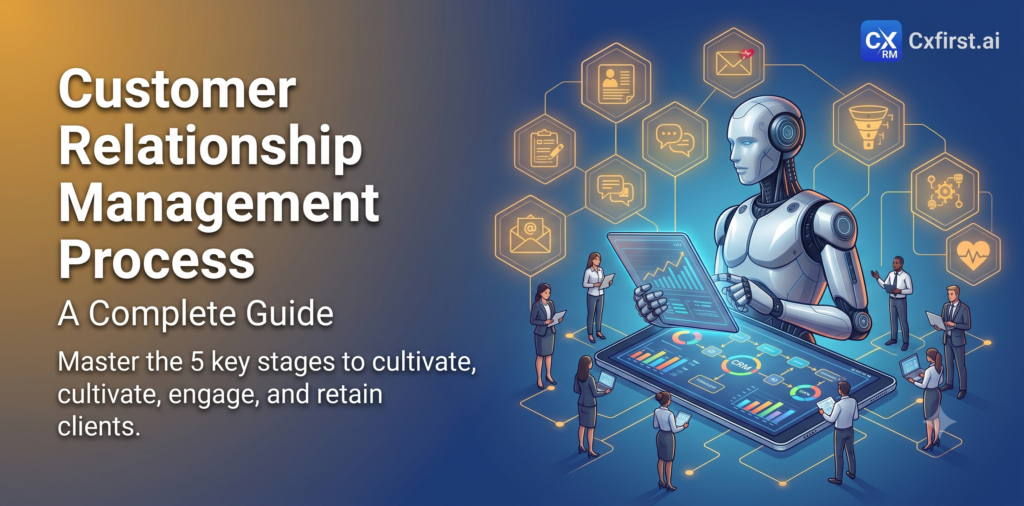
The 5 Key Stages of the Customer Relationship Management Process
Stage 1: Customer Awareness and Lead Generation
Customer relationship management starts before anyone’s bought anything. Marketing campaigns and paid ads bring people to a website. Some of them fill out a form, and that’s a lead. Social media pulls in a different crowd – people who found you through content, not a sales pitch. Referrals matter too, arguably more than the rest, since someone recommending you already carries built-in trust. Whatever channel it comes through, the job at this stage is just to capture the lead before that initial spark of interest fades.
Stage 2: Lead Qualification and Customer Acquisition
Not every lead is ready to buy right now, and pretending otherwise wastes everyone’s time. Lead scoring helps here – tracking things like page visits or email opens to figure out who’s actually warming up. From there it’s a real sales conversation: understanding what the prospect needs, running a demo if it makes sense, and working through whatever’s holding them back. If it clicks, the lead becomes a customer.
Stage 3: Customer Onboarding
Whatever happens in the first few weeks after someone signs on tends to set the tone for the whole relationship. A decent welcome process reassures a new customer they made the right call. Getting them set up with the product, walking them through training, and being available for the inevitable early questions – none of that is optional if you want them to stick around. And setting expectations early, about timelines, support hours, what’s included and what isn’t, saves a lot of headaches later.
Stage 4: Customer Engagement and Relationship Building
This is the stage people neglect most, mostly because it never really ends. Once someone’s onboarded, the customer engagement process needs upkeep, or it goes stale. Personalized messages that actually reflect what a customer’s doing – not generic blasts – land better. So does being reachable across whatever channel a customer prefers, without losing track of the conversation history when they switch from chat to email. Regular check-ins and asking for feedback before something goes wrong both matter more than people give them credit for.
This is also where a lot of teams start drowning. Too many channels, too many one-off conversations, not enough hours in the day. That’s the gap platforms like CXFirst.ai are built to close – using AI to manage customer conversations across channels so responses stay fast without needing to double headcount.
Read more blog : The Real Estate Agent’s Guide to Choosing an AI Assistant in 2026
Stage 5: Customer Retention and Loyalty
This is where the actual long-term revenue lives. Customer success work – making sure people are actually getting value out of what they bought – matters more here than almost anywhere else in the process. Renewal conversations should feel like a check-in, not a transaction. Upselling and cross-selling can work, but only when it genuinely fits what the customer needs, not just what’s easiest to sell. Loyalty programs give repeat customers a reason to stick around, and none of it works without ongoing attention – proactive outreach, regular reviews, actually showing up after the sale is done.
Common Challenges in the CRM Process (and How to Overcome Them)
Poor Data Quality
Duplicate contacts, outdated numbers, missing fields – it adds up fast and quietly wrecks every stage downstream. Regular audits and requiring key fields at entry keep this from spiraling.
Lack of Team Collaboration
Sales, marketing, and support working in silos is how customers end up repeating themselves. Shared dashboards and clear rules about who owns what stage help, but only if people actually use them.
Manual Processes
Typing up every call log and follow-up reminder by hand eats hours that could go toward talking to actual customers. Automating the repetitive stuff frees people up for the parts that need a human.
Inconsistent Customer Communication
When tone and messaging swing wildly depending on who’s replying, customers notice – and not in a good way. Templates and a documented customer management process help, as long as they don’t make everything sound scripted.
Low Customer Engagement
Customers who never hear from you are the easiest ones to lose. Scheduled touchpoints and outreach that doesn’t wait for a problem to show up keep the relationship from going cold.
Why Businesses Are Modernizing Their CRM Process with CXFirst.ai
A lot of these problems boil down to the same root cause: teams trying to run a growing customer base through a process built for a much smaller one. That’s usually where AI starts making a real difference.
CXFirst.ai folds AI-powered customer engagement straight into the CRM process – handling omnichannel communication from one place instead of juggling five separate inboxes and chat tools. Workflow automation takes the manual busywork off people’s plates, and real-time analytics give leadership an actual view into what’s happening at each stage of the lifecycle, not just a guess. The payoff shows up as faster response times, better customer satisfaction, and a system that can grow with the business instead of requiring twice the headcount every time customer volume doubles.
Frequently Asked Questions
It’s the structured approach a business uses to manage every customer interaction, from the first contact all the way through long-term retention, so nothing depends on guesswork or memory.
Five, generally: awareness and lead generation, qualification and acquisition, onboarding, engagement and relationship building, and retention and loyalty.
Because it’s what makes customer experience consistent, keeps teams working from the same playbook, catches churn risks early, and lets a business grow without the service quality falling apart along the way.
It’s the infrastructure – where contact records, communication history, and deal tracking live – that makes a defined CRM workflow something you can actually run and measure, instead of just an idea on a whiteboard.
Definitely. Even a fairly basic version of this process helps a small team avoid dropped leads and gives customers the kind of consistent experience that’s usually associated with much bigger companies.
Conclusion
A real customer relationship management process is worth more than a tidy contact list – it’s what actually builds relationships that last past the first sale. Businesses that stick to a clear, repeatable approach tend to see it show up in retention numbers and long-term growth, not just customer satisfaction surveys.
Customer expectations aren’t going to level off anytime soon. The businesses pulling ahead are the ones pairing a solid CRM strategy with tools built for how people actually communicate now – not five years ago. If that’s the direction you’re headed, it’s worth seeing what CXFirst.ai does with AI-driven automation, omnichannel communication, and the kind of everyday insight that turns routine interactions into relationships that stick.
Ready to see CXFirst.ai in action?
Talk to our team and find out how an AI-native platform can transform your customer experience.
Book a Demo