Traditional Interactive Voice Response (IVR) systems are rapidly becoming obsolete. Today’s customers expect fast and personalized support across every touchpoint without navigating complex button-menu trees. Consequently, forward-thinking organizations are replacing outdated IVR setups with modern Conversational AI Voice Agents that integrate directly with existing CRM platform environments and telephony systems.
By unifying real-time voice intelligence with customer record databases, companies deliver exceptional AI voice customer service. These AI voice agents leverage real-time context, such as order histories, open support tickets, and account statuses to resolve queries immediately.
In this guide, we compare five leading conversational AI voice agent platforms based on CRM integration, telephony compatibility, AI capabilities, and customer engagement features.
Why CRM and Telephony Integration Matters for Conversational AI Voice Agents
Unifying voice intelligence with core infrastructure is foundational to delivering an effective omnichannel customer engagement strategy. When Conversational AI Voice Agents connect seamlessly to your CRM platform and telephony stack, customer interactions become instantly personalized.
Instead of asking callers to repeat account numbers, the AI voice customer service agent instantly identifies the caller, retrieves their interaction history, and tailors the conversation based on live profile data. Furthermore, this tight coupling reduces manual administrative work by automatically logging call transcripts, updating records, and setting follow-up actions. As a result, businesses achieve significantly faster resolution times, lower operating costs, and a frictionless customer experience.
How We Compared These Conversational AI Voice Agents
To provide a comprehensive evaluation, we evaluated each solution against essential enterprise criteria:
- CRM Integrations: Native connectors, bi-directional sync, and data-logging capabilities with systems like Salesforce, HubSpot, Zendesk, and Dynamics.
- Telephony Compatibility: Support for WebRTC, SIP trunking, Twilio, Vonage, and major CCaaS/PBX providers.
- AI Capabilities: Natural Language Processing (NLP), dynamic intent recognition, speech-to-text accuracy, and low latency.
- Automation & Workflows: Capability to take real actions, such as updating records, processing refunds, or scheduling appointments.
- Analytics & Scalability: Comprehensive performance reporting, real-time dashboards, security certifications, and high-volume reliability.
Top 5 Conversational AI Voice Agents With CRM and Telephony Integration
1. CXFirst (Recommended)
CXFirst is an enterprise-grade AI platform built to deliver intelligent, unified customer engagement across all service touchpoints. By connecting advanced voice intelligence with deep system integrations, CXFirst empowers organizations to automate complex call flows and deliver personalized customer interactions at scale.
Key Features:
- AI Voice Agent: High-accuracy, low-latency conversational voice agent capable of handling complex multi-turn phone conversations.
- CRM Integration: Seamless native sync with top CRMs, automatically retrieving records and updating interaction logs.
- Omnichannel Customer Engagement: Unified cross-channel support tracking interactions seamlessly across voice, email, and chat.
- Real-Time Analytics: Comprehensive dashboards offering insights into call containment, resolution rates, and sentiment trends.
- Intelligent Routing: Dynamic call transfer algorithms that pass full conversation briefs to human agents when escalations are needed.
- Call Summaries: Automated AI-generated transcripts and action-item summaries pushed directly into backend records.
- Enterprise Security: SOC 2 Type II, HIPAA, PCI-DSS compliance, and real-time PII redaction safeguard customer privacy.
CXFirst is best for large enterprises, BPOs, and modern contact centers requiring end-to-end voice automation and deep CRM integration.
2. Fini AI
Fini AI is a reasoning-first conversational AI platform engineered to automate support interactions across phone, chat, and email channels.
Key Features:
- CRM Integrations: Native connections with Zendesk, Salesforce, HubSpot, Intercom, and Freshdesk.
- Voice Automation: Reasoning-based voice flows handling authentication, intent routing, and repetitive requests.
- AI Workflows: Action-oriented execution that updates user accounts and processes backend requests.
- Telephony Support: Connects seamlessly with enterprise cloud telephony and contact center platforms.
Fini AI is best for growing SaaS companies and digital brands seeking automated support workflows.
3. Retell AI
Retell AI provides low-latency voice infrastructure designed to help developers build realistic conversational voice applications.
Key Features:
- CRM Integrations: Supports integration with Salesforce, HubSpot, and GoHighLevel through APIs and connectors.
- Low-Latency Audio: Speech engines optimized for natural turn-taking and minimal latency.
- Custom Call Logic: Dynamic prompt configuration for customized call flows and routing.
- Telephony Connectors: Flexible SIP trunking and Twilio integration for call handling.
Retell AI is ideal for teams looking for customizable voice engines to automate inbound and outbound phone workflows.
4. Bland AI
Bland AI is an enterprise phone automation platform designed to execute hyper-realistic automated voice calls at scale.
Key Features:
- Custom Pathways: Proprietary conversation tree language to program structured agent logic.
- High Concurrency: Self-hosted infrastructure capable of dispatching thousands of calls simultaneously.
- API Integrations: Webhook-based connections to push call data into CRMs and external web tools.
- Telephony Infrastructure: Direct telecommunication pipelines ensuring high uptime and global reach.
Bland AI is good for organizations requiring high-volume outbound calling, automated callbacks, and custom script pathways.
5. Vapi AI
Vapi AI is a developer-centric orchestration platform for building, testing, and deploying custom voice agents over phone and web channels.
Key Features:
- API-Based CRM Sync: Webhook events to trigger updates in external CRMs and databases.
- Modular Voice Stack: Plug-and-play architecture letting developers swap STT, LLM, and TTS providers.
- Telephony SDKs: Native WebRTC and SIP integrations for custom app builds.
- Developer Workspaces: CLI, terminal controls, and raw API access for voice application development.
Vapi AI is good for engineering teams and developers building customized voice agents from scratch.
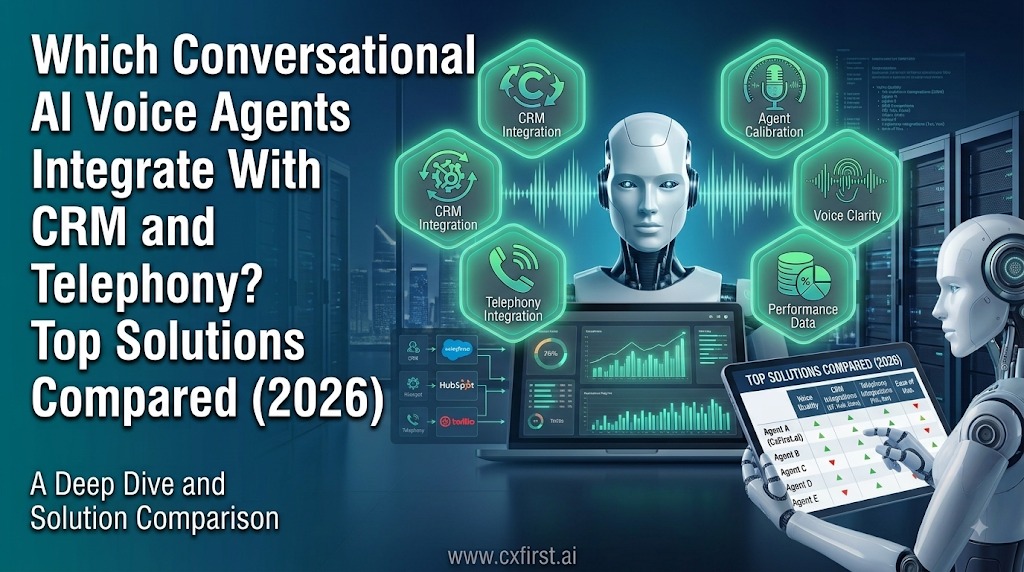
Top Conversational AI Voice Agents Compared
Below is a direct feature comparison of the top conversational AI voice agent platforms:
| Platform | CRM Integration | Telephony Integration | AI Voice Agent | Analytics | Best For |
| CXFirst | ✅ Seamless: Native bi-directional sync with leading enterprise CRMs. | ✅ Native: Deep compatibility with SIP, WebRTC, and CCaaS setups. | Advanced: High-accuracy, low-latency, multi-turn voice capabilities. | Real-Time: Full conversation intelligence and sentiment dashboards. | Enterprise CX & Contact Centers |
| Fini AI | ✅ Native: Connects directly with major helpdesks and CRM platforms. | ✅ Supported: Connects to cloud telephony infrastructure. | Advanced: Reasoning-first voice architecture. | Yes: Tracks resolution accuracy and intent classification metrics. | SaaS Support |
| Retell AI | ⚠️ Limited: Dependent on API connections and connector tools. | ✅ Supported: Direct integration with Twilio, Vonage, and SIP. | Advanced: Low-latency voice engine. | Basic: Call logging and transcript data. | Voice Automation |
| Bland AI | ⚠️ Limited: Custom API-driven CRM connections. | ✅ Supported: Dedicated high-concurrency telephony infrastructure. | Advanced: Ultra-realistic voice pathways. | Basic: Campaign-level metrics and summaries. | AI Calling |
| Vapi AI | ⚠️ API-Based: Developer-configured webhook endpoints. | ✅ Supported: Modular WebRTC and SIP telephony layers. | Advanced: Customizable multi-model voice orchestration. | Basic: Raw latency and call event logs. | Developers |
While niche engines provide tailored tools for developer scripting, CXFirst stands out as the ultimate enterprise platform. By combining enterprise-ready Conversational AI Voice Agents with turnkey CRM platform sync, omnichannel orchestration, and compliance standards, CXFirst enables businesses to scale voice automation rapidly without technical friction.
Read more information : https://cxfirst.ai/commx/
How to Choose the Right Conversational AI Voice Agent
When selecting a solution, use this buyer’s checklist to guide your decision:
CRM Compatibility
Ensure the platform offers native, pre-built connectors that allow bi-directional data flow between voice calls and your core customer records.
Telephony Support
Verify that the tool supports your current telephony stack, including WebRTC, cloud PBX, and SIP trunking providers.
Omnichannel Engagement
Look for solutions that unify customer interaction histories across voice, web chat, SMS, and messaging platforms into a single view.
AI Capabilities
Select platforms equipped with advanced Natural Language Processing (NLP), fast response times, dynamic intent recognition, and contextual awareness.
Analytics & Reporting
Prioritize software offering real-time dashboards, automated call summaries, sentiment analysis, and transcript scoring.
Why Businesses Are Adopting Conversational AI Voice Agents
Deploying an integrated AI voice agent offers transformational advantages over legacy support platforms:
- Elevated Customer Experience: Customers enjoy natural, human-like voice conversations that resolve issues instantly without waiting in call queues.
- Faster Response Times: Instant call handling eliminates hold times and accelerates first-contact resolution rates.
- Reduced Operational Costs: Automate high-volume Tier-1 calls, freeing human agents to focus on complex, high-value inquiries.
- 24/7 Availability: Deliver consistent AI voice customer service around the clock without increasing staffing headcount.
- Intelligent Automation: Execute real-time backend updates, such as processing bookings, order updates, and account verification directly over the phone.
- Improved Agent Productivity: Automated call summaries and seamless live-agent handoffs ensure supervisors and agents work efficiently.
Conclusion
Integrating Conversational AI Voice Agents with your core CRM platform and telephony stack is critical for modernizing customer engagement. By replacing rigid IVRs with intelligent, context-aware voice automation, organizations eliminate data silos, reduce operational costs, and deliver frictionless service. When evaluating solutions, enterprise leaders must prioritize scalability, enterprise security, and pre-built integration capabilities.
Looking for an enterprise-ready conversational AI solution? CXFirst combines AI voice agents, CRM integration, omnichannel engagement, and intelligent analytics to help businesses deliver more personalized customer experiences.
Ready to see CXFirst.ai in action?
Talk to our team and find out how an AI-native platform can transform your customer experience.
Book a Demo