
Introduction
Nobody likes pressing 1 for billing. You know the drill – stuck in some phone tree at 9 pm, hunting for the one option that doesn’t loop you right back to the start, and half the time you just give up and hang up. That’s the whole reason businesses are pulling old IVR systems out and putting in something that actually listens instead of routing off a keypress.
Contact centers have it rough this year. Call volume’s up, a lot of teams are short-staffed, and people still expect someone, or something, to pick up at 9 pm on a Sunday. No sales pitch here. Just what an AI call center voice agent is, how it actually works, what makes one good versus mediocre, and how to pick a provider without regretting it six months in.
What Is an AI Call Center Voice Agent?
Short version. It’s software that picks up your phone line and holds an actual conversation – understands the question, not just a magic word it’s waiting to hear. No menu. No script. A conversation.
IVR breaks the second you step off-script. Wrong phrase, or the right phrase said the wrong way, and you’re stuck starting over. Chatbots are a different animal, since text has no tone and nobody’s interrupting anybody. Voice is just harder. Tone, pace, the awkward pause before someone finishes a sentence, all of that has to get handled in real time.
Conversational AI is the piece doing the heavy lifting here. It listens, works out what you actually mean rather than what you literally said, and answers the way a person would, adjusting mid-call instead of sticking to a script line by line. Support calls, booking an appointment, checking where an order is, qualifying a lead before a rep even gets on the phone – same core system handles all of it.
How AI Voice Agents Work
Five pieces, all firing in a second or two on a real call, sometimes less.
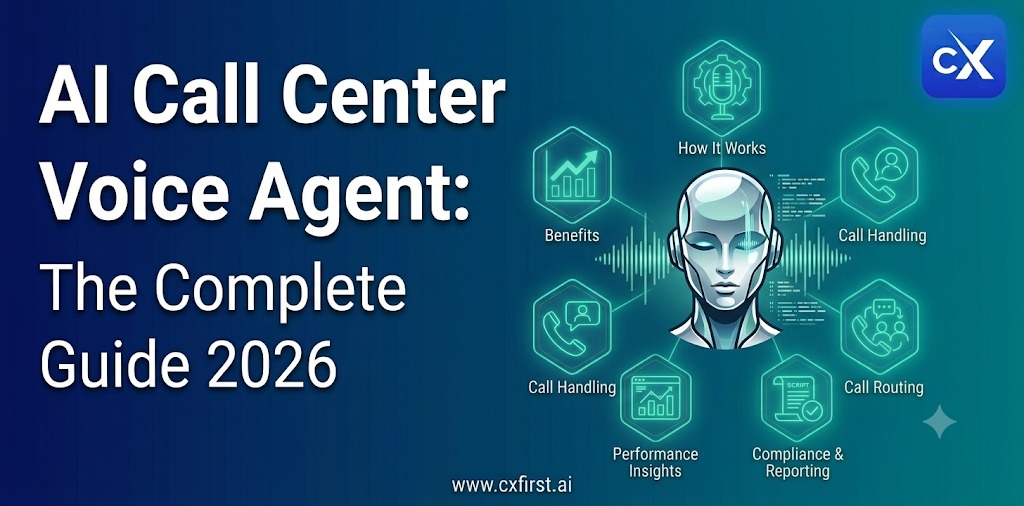
ASR, Speech Recognition, turns whatever’s spoken into text the system can work with. NLU takes that text and figures out what the caller actually means – “where’s my order” and “I never got my package” have to land on the same answer even though the words don’t match at all. A Large Language Model decides how to respond from there, weighing the whole conversation instead of just reading a script. Text-to-Speech turns that decision into audio that sounds like an actual person, not a robot narrating a manual. And CRM & Backend Integrations are what make any of this useful day-to-day – updating a record, booking a slot, or handing off to a live agent the second the call actually needs one.
Top Benefits of AI Call Center Voice Agents
- Instant Response to Every Customer. No hold music. The system picks up immediately, every single time, no matter how many calls come in at once.
- Intelligent Call Routing. Calls land in the right place the first time, based on what’s actually being asked instead of a guess.
- Automated FAQs & Self-Service. The stuff agents answer fifty times a day gets handled instantly now.
- Appointment Booking & Scheduling. Customers book, move, or cancel appointments just by saying so.
- Lead Qualification. The bot asks the right questions upfront so sales reps aren’t wasting time on leads going nowhere.
- Order Tracking & Status Updates. “Where’s my package?” gets answered in seconds, pulled straight from the system.
- Multilingual Customer Support. One system, several languages, no separate team required for each.
- Real-Time Analytics. Every call generates data on sentiment and resolution as it happens, not in some report three weeks later.
Best Voice AI Agents: What Features Should You Look For?
Not every voice AI platform is built the same, and the differences show up fast once you’re actually using one.
Natural Human-Like Conversations
If a caller can tell in the first ten seconds they’re talking to something that doesn’t get them, you’ve already lost them.
Low-Latency Responses
A half-second delay feels enormous on a phone call. Responses need to come fast enough that it feels like a real back-and-forth.
Omnichannel Support
Context should carry over whether someone calls, texts, or messages through an app.
CRM Integration
Without this, you’ve basically built an expensive answering machine.
Knowledge Base Integration
Answers should pull from whatever documentation the business already has, kept current automatically.
AI Learning & Continuous Improvement
The system should get sharper the more calls it handles.
Enterprise-Grade Security
Every call touches customer data. That needs real encryption and real access controls, not a checkbox.
Custom Workflow Automation
No two businesses run the same way, so why would the same rigid workflow work for both? A good system flexes around your process instead of forcing you into somebody else’s template.
Best Voice AI Providers: Evaluation Checklist
Before you sign anything, run through this list. It’ll save you a headache later.
- Ease of Deployment – how fast can this actually go live, and how much of that work falls on your team versus theirs?
- Scalability – can it handle triple the volume during a busy season, or does it choke the first time things get hectic?
- Customization Options – is it shaped around your process, or are you the one doing the adapting here?
- AI Accuracy – how often does it actually get things right, and what’s the fallback when it doesn’t?
- Compliance & Security – does it hold up against what your industry actually demands, not just what sounds good in a pitch deck?
- Pricing Model – usage-based, seat-based, flat fee, whichever it is, does it match how your call volume actually behaves month to month?
- Support & Implementation – something breaks at 2 am. Who’s picking up the phone on their end?
AI Call Center Voice Agent vs Traditional IVR
| Feature | AI Voice Agent | Traditional IVR |
| Conversational | ✅ | ❌ |
| Understands Context | ✅ | ❌ |
| Handles Complex Queries | ✅ | Limited |
| Learns Over Time | ✅ | ❌ |
| 24/7 Support | ✅ | ✅ |
| CRM Integration | Advanced | Basic |
How to Choose the Best Voice AI Call Center Provider
Define Your Business Goals
Start with your actual goals. Are you trying to cut wait times? Reduce agent burnout? Handle more volume without hiring? The answer changes what you should be looking for.
Assess Voice Quality
Get on a real demo call before you sign anything. A voice that sounds even a little off puts people on edge right from hello.
Check Integration Capabilities
Make sure the integration genuinely talks to your CRM and helpdesk, and don’t just take a salesperson’s word for it; ask them to show you.
Evaluate Security Standards
Ask directly about encryption and compliance certs relevant to your industry.
Review Analytics Features
Look at the analytics, and make sure they tell you something useful, not just call counts.
Test Scalability
Run a small pilot, then push volume up and see where it actually breaks.
Compare Total Cost of Ownership
And look past the sticker price. Implementation, training, and ongoing support all add up, and that’s the number that actually matters.
Why CXFirst AI Is a Leading AI Call Center Voice Agent
Human-Like Voice Conversations
We built CXFirst AI around one idea: voice interactions should sound like an actual conversation, not a script being read aloud. That difference shows up from the first exchange.
AI-Powered Customer Support Automation
Routine queries get handled automatically here, which frees your live agents for the calls that need real judgment.
Enterprise-Grade Security
Security runs deep, built for businesses handling sensitive data at real scale, not a bolt-on afterthought.
Omnichannel Customer Engagement
Conversations stay consistent whether someone calls, chats, or messages, with context following the customer everywhere.
CRM & Business System Integrations
The platform plugs directly into your existing CRM and business systems instead of sitting apart from them.
Intelligent Workflow Automation
Workflows get built around how your business actually operates.
Real-Time Analytics & Reporting
You get real-time visibility into call patterns and sentiment as they happen.
Rapid Deployment for Contact Centers
And deployment doesn’t take months, which matters when your call volume problem is happening today, not next quarter.
Final Thoughts
AI voice agents have gone from an experimental upgrade to something close to a baseline expectation for any contact center that wants to keep up. Picking the right provider comes down to a handful of things that actually matter: voice quality, integration depth, security, and whether it holds up once real volume hits it. CXFirst AI brings all of that together, helping businesses automate customer interactions in a way that actually improves the experience while cutting costs at the same time.
Frequently Asked Questions
Software that holds real phone conversations with customers, understanding intent and responding naturally instead of relying on a fixed menu.
It answers instantly, routes calls accurately, and handles routine requests around the clock, cutting wait times and freeing up human agents for harder issues.
IVR reacts to specific inputs and breaks down outside a narrow script. AI voice agents understand context, so they handle a much wider range of requests.
The strongest options combine natural conversation quality, deep CRM integration, enterprise security, and real scalability. CXFirst AI was built with exactly those requirements in mind.
Ready to see CXFirst.ai in action?
Talk to our team and find out how an AI-native platform can transform your customer experience.
Book a Demo